
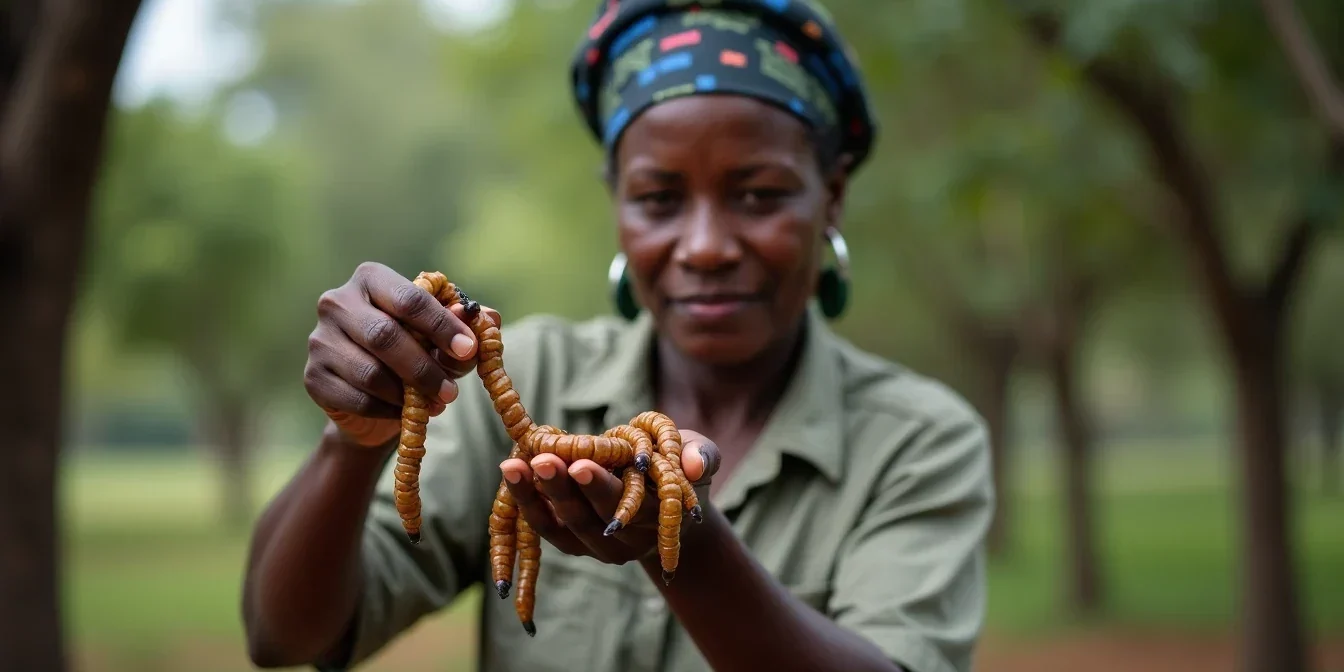
Mopane worms have spent generations being treated like a rough, rural staple by people who know better than to waste a seasonal food that delivers serious nourishment. Now the global wellness world is circling back to the same ingredient with fresh enthusiasm, as if the best ideas only count once they are packaged, powdered, and discussed at a conference.
This is the real irony. Southern Africa never lost the plot. Communities across the region already knew these caterpillars, harvested from mopane trees and dried for storage, offered a dense hit of protein, iron, zinc, and amino acids. The new conversation isn’t about discovering Mopane worms; it’s about whether modern food systems can finally catch up.
An old food with a hard nutritional edge
Dried Mopane worms can contain roughly 50 to 60 percent protein by dry weight, putting them in a very different category from usual supermarket proteins. Beef, chicken, and fish all bring value, but they do not come close to that concentration once moisture is removed. This is why Mopane worms have mattered for so long in rural diets: they deliver a lot of nutrition in a small amount of food.
What they bring to the table
A good Mopane worm product should do more than flatter a trend. It should offer:
- High protein content for repair, recovery, and satiety
- Iron, especially useful in diets where low intake is common
- Zinc, which supports immune function and metabolism
- Essential amino acids, including the full set the body cannot make on its own
- Additional minerals such as calcium, phosphorus, magnesium, and potassium
- Natural fats, including unsaturated fatty acids
That is a serious profile for a food many people still dismiss on sight. The bias is usually cultural, not nutritional. Once dried and processed properly, Mopane worms are closer to a concentrated protein ingredient than the squeamish reaction their nickname invites.
Why the environment keeps bringing the conversation back
Edible insects keep appearing in sustainability discussions for a simple reason. They ask far less of the land, the water supply, and the climate than conventional livestock. Mopane worms are wild-harvested from mopane trees, so they do not need feedlots, grazing land, or irrigation in the way cattle or other farmed animals do. They exist inside an already functioning ecosystem.
This matters more every year as climate pressure, land use strain, and water scarcity bite harder. The Food and Agriculture Organization of the United Nations has already identified edible insects as one promising part of future food systems, and the logic is easy to see. Insects generally turn feed into body mass efficiently and produce far fewer greenhouse gases than ruminant livestock. Estimates in the research literature put the emissions advantage at many times lower per kilogram of protein.
Mopane worms fit that argument neatly because they are not a shiny laboratory invention. They are an existing food with an established ecological niche. The sustainability case is not theoretical; communities who harvest them as part of ordinary survival have lived it, season after season.
What communities already knew
Across South Africa, Botswana, Zimbabwe, and Namibia, Mopane worms have long supported household nutrition and seasonal cash income. The harvest usually arrives during the rainy months, from about December to April, when the caterpillars are abundant and families can collect, boil, dry, and store them. That rhythm is traditional food knowledge shaped by ecology.
The cultural side of the harvest
For Venda, Tsonga, Pedi, Ndebele, San, and Ovambo communities, Mopane worms are not a novelty snack. They are part of the region’s food memory. Some households cook them into stews, others fry them, and many keep them dried for later use or sale. The harvest brings work, income, and a kind of seasonal momentum that matters in areas where food options can be limited.
Women are central to that economy. In many places, the collecting, cleaning, drying, and trading of Mopane worms provides a valuable stream of income for rural families. That local value should matter as much as any glossy global market story. A future food that ignores the people already carrying the knowledge is not a future worth praising.
The wellness opportunity is in the processing
The most interesting shift is not simply that Mopane worms can be eaten. It is that they can be turned into higher-value products that are easier to store, transport, and use in modern routines. Protein powders, supplements, fortified snack bars, crackers, pasta, and cereal blends all make sense here.
Product formats that actually fit modern buying habits
If Mopane worms are going to move from traditional harvest to wellness shelf, the formats need to match how people shop:
- Protein powders for shakes and recovery blends
- Encapsulated supplements for targeted iron or zinc support
- Snack foods for on-the-go protein
- Flour for baking and food fortification
- Functional drink ingredients for smoothies and meal replacements
This is where local value can stay local. Instead of exporting raw harvests and importing finished goods, African processors could keep more of the margin by making the ingredient into something premium on the continent. That is a better story than shipping out a traditional food and buying it back in a capsule.
What to look for before buying
If Mopane worm products start appearing in wellness ranges, the label should do the heavy lifting. A buyer should be able to see what form the ingredient takes, how it was processed, and whether the product is meant as a whole food, a powder, or a supplement.
Simple buying checks
- Ingredient list, with Mopane worm clearly named
- Protein content per serving, not just marketing claims
- Iron and zinc amounts if the product is positioned as a mineral support item
- Processing method, especially drying and milling
- Sourcing information that shows African origin and responsible harvest practices
- Taste and mixability if it is sold as a powder or blended ingredient
The best products will not pretend to be something else. They will lean into the ingredient’s natural density and keep the formula clean enough to be useful.
Mopane worms are a reminder that not every future food comes from a startup pitch deck. Some of the strongest answers were already on the table, waiting for the rest of the world to stop sneering long enough to notice.